ESTRO 2026 congress report
Report by the ESTRO Lung Focus Group
1. Report on Lung Session 3, Proffered Papers, Clinical track
Safety and Toxicity of Stereotactic Body Radiotherapy (SBRT) for Centrally Located Tumours: Interim Results from the STRICT Lung Trial (a multi-centre Phase II Study)
Central and ultra-central lung lesions still represent a major challenge in Radiation Oncology, as delivering ablative doses safely is complicated by their proximity to sensitive organs of interest (proximal bronchial tree (PBT), oesophagus, etc.). Data from a previous study (such as HILUS) showed good local control, but with AE G5~13-15%.
Mette Pøhl, from Denmark, reported the interim results of the STRICT lung trial (a multi-centre phase II Study on SBRT for centrally located tumours), focusing on safety and adverse events, during the Proffered Paper session on Monday, 18 May 2026.
Centrally located tumours were defined as within 0.5-2.5 cm of the PBT or oesophagus, or within 0.5 cm of the heart or aorta. Tumour diameter ≤ 5 cm, and SBRT was delivered in 8 fx.
Primary dose-planning priority was organ-at-risk (OAR) constraints; second priority was target coverage, aiming for 95% of the PTV to receive 95% of the prescribed 56 Gy dose, allowing dose escalation within the gross tumour volume (GTV) to mean doses up to 85 Gy.
The primary endpoint was the incidence of Grade 4–5 AE, while secondary endpoints included OS and overall toxicity. The AEs were recorded and graded according to the CTCAE v5.0.
Between February 2022 and October 2025, 98 pts were treated: 73 with primary lung cancer and 25 with pulmonary metastases. The median f-up time was 9.6 months (IQR 3.6-20.9 months) from treatment initiation. 2 G5 5 (2%) AE occurred: 1 sudden death (unrelated) and 1 fatal haemoptysis (related), due to palliative type 1 re-RT 14 months after central SBRT, with haemoptysis occurring 8 months later. No G 4 AE were observed. 12 pts (12.2%) experienced G3 infection. The other most frequent ≥ 3 toxicities were dyspnoea (12.2%) and fatigue (10%).
These interim results support the safety and feasibility of SBRT for central lung lesions when delivered according to strict, protocol-defined dose constraints.
Single-fraction SABR for primary NSCLC and lung oligometastases: A pooled analysis of 1,691 patients
Single-fraction SABR in the treatment of lung tumours is gaining increasing interest worldwide, but what about local control and adverse events?
Neil Wallace from Australia presented the results of 1,691 pts (≥18 years old) treated with SABR for primary NSCLC or lung metastases at Roswell Park Comprehensive Cancer Centre, the Cleveland Clinic and Peter MacCallum Cancer Centre between September 2008 and December 2022, on 18 May 2026.
A retrospective review of all clinical, radiological and histological encounters was performed by local investigators. Outcomes, including local/distant failure, survival, and adverse events, were recorded.
1,691 patients were included. Median f-up was 51 months. Median age was 73.1834 (49%) were male, and 992 (68%) were medically inoperable. Median maximum tumour dimension was 17.0mm (IQR 12.0-23.0).
The most frequent prescription doses were 34Gy (39%), 30Gy (23%) and 28Gy (17%); range 26-34Gy. 1,201pts (71%) were treated for primary NSCLC, with a median age of 75.0 and ECOG PS of 0 (26%), 1 (54%), 2 (18%), 3 (2%). Histological confirmation was obtained for 880 (74%), with 446 (51%) adenocarcinoma, and 301 (34%) squamous cell carcinoma.
490 (29%) had pulmonary oligometastases, with a median age of 68.0, and ECOG was 0 (59%) or 1 (33%) in most cases. The most frequent histologies were colorectal cancer (27%) and NSCLC (19%).
G3+ adverse events were observed in 31/1236 (2.5%) pts. There were 2 G4 events (pneumonitis and pleural effusion) and 1 episode of G5 pneumonitis.
Local control at 5 years was 88% (95% CI 84,91) for primary NSCLC and 83% (95% CI 73,89) for pulmonary oligometastases.
Median PFS was 30 months (95% CI 27,34) for primary NSCLC and 10 months for pulmonary oligometastases (95% CI 9,12). Rates of regional nodal-only and distant failure for primary NSCLC at 5 years were 5% (95% CI 3,6) and 19% (95% CI 16,21), respectively. Median overall survival was 40 months (95% CI 36,43) for primary NSCLC and 50 months (95% CI 42,57) for pulmonary oligometastases.
Single-fraction SABR is a safe and effective treatment for primary NSCLC and pulmonary oligometastases.
Valeria Dionisi
Radiation Oncologist
Radiation Oncology Department
University and Hospital Trust, Verona, Italy
valeria.dionisi@gmail.com
valeria.dionisi@aovr.veneto.it
Member of the ESTRO Lung Focus Group

2. Biomarker-Driven Radiotherapy and Emerging Biological Targets in Lung Cancer
Teaching Lecture
A recurring theme throughout ESTRO 2026 was the transition from conventional radiotherapy to biologically individualised treatment strategies. This concept was comprehensively reviewed during the teaching lecture “Biomarker-driven radiotherapy trials: shaping the future of personalised cancer care” by Professor Ludwig Dubois from The University of Manchester, United Kingdom.
Professor Dubois highlighted a fundamental limitation of current radiotherapy practice. Despite remarkable advances in imaging, treatment planning and delivery, most radiotherapy approaches remain based on tumour location and stage. However, clinical outcomes vary substantially among patients receiving identical treatment regimens. While some patients achieve durable tumour control with minimal side effects, others experience recurrence or significant adverse effects despite apparently optimal treatment.
To address this challenge, Professor Dubois reviewed several classes of radiotherapy biomarkers. Genomic biomarkers include signatures such as the Radiosensitivity Index (RSI) and the Genomic-Adjusted Radiation Dose (GARD), which aim to quantify intrinsic tumour radiosensitivity and predict benefit from radiation treatment, while other molecular biomarkers focus on DNA damage repair deficiencies, tumour mutational burden, and proliferative capacity.
Particularly relevant for thoracic oncology was the discussion of dynamic biomarkers, especially circulating tumour DNA (ctDNA). Early changes in ctDNA during and after treatment may provide a real-time measure of treatment effectiveness. Data from non-small cell lung cancer (NSCLC) cohorts suggest that rapid ctDNA clearance correlates with favourable outcomes, whereas persistent ctDNA identifies patients at increased risk of recurrence despite apparent radiographic response. Such biomarkers could ultimately support adaptive treatment strategies based on biological rather than anatomical response.
A major focus of the lecture was tumour hypoxia, one of the most extensively validated causes of radioresistance. Hypoxic tumour cells require approximately three times the radiation dose needed to achieve equivalent cell kill under normoxic conditions. Functional imaging techniques using hypoxia-specific positron emission tomography tracers, including fluoromisonidazole (FMISO), fluoroazomycin arabinoside (FAZA) and HX4, have demonstrated substantial intratumor heterogeneity and frequently provide information complementary to conventional fluorodeoxyglucose (FDG)-PET imaging.
Professor Dubois argued that previous failures of hypoxia-targeted therapies may be explained partly by inadequate patient selection. Hypoxia-activated prodrugs and oxygen-modifying interventions have often been evaluated without stratifying patients according to baseline hypoxia status. Future biomarker-driven trials may therefore benefit from selecting patients most likely to derive benefit from biological interventions.
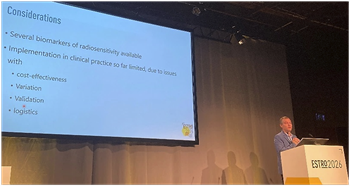
The lecture concluded with a powerful message: numerous promising radiotherapy biomarkers already exist, but implementation remains limited by validation, logistics and cost-effectiveness challenges. Nevertheless, biomarker-led prospective trials are increasingly feasible, bringing personalised radiotherapy closer to routine clinical practice.
MONDRIAN; Multi-omics integrative modelling for SBRT in early-stage NSCLC

An important example of how biomarker-driven radiotherapy is being translated into clinical research was presented by Dr Stefania Volpe from Italy during the poster discussion session on lung cancer. The MONDRIAN study (NCT05974475) is a prospective multi-centre initiative designed to develop integrated predictive models for patients with early-stage NSCLC treated with stereotactic body radiotherapy (SBRT).
The first analysis included 194 patients and combined multiple layers of biological and imaging information, including transcriptomic profiling of peripheral blood leukocytes, tumour proteomics and radiomic imaging features. By integrating these complementary data sources, investigators aim to identify biomarkers capable of predicting treatment response, recurrence risk and long-term outcomes following SBRT.
Particular attention is being paid to hypoxia-associated signatures, reflecting the growing recognition that tumour oxygenation status remains one of the most important determinants of radiosensitivity. The study, therefore, aligns closely with themes discussed by Professor Ludwig Dubois, who highlighted hypoxia as one of the most clinically validated radiotherapy biomarkers and emphasised the need for improved patient stratification in future biomarker-guided trials.
Although no significant differences in clinical outcomes have yet emerged between the study cohorts, the MONDRIAN project represents one of the most ambitious efforts to integrate radiomics, proteomics and transcriptomics into a single decision-support framework for lung cancer radiotherapy. The study may provide valuable insights into how multi-omics approaches can be incorporated into routine clinical practice and support a transition from population-based treatment strategies towards truly personalised radiotherapy.
Metabolic Plasticity and Mitochondrial Recovery: Emerging Targets for Radiosensitisation
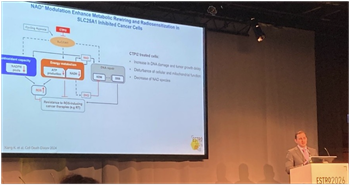
Another major radiobiological theme at ESTRO 2026 was the growing recognition that metabolic adaptation contributes substantially to tumour radioresistance. During the invited speaker session “Metabolism and Mitochondria in the Spotlight: Novel Radiosensitisation Targets,” Dr. Johann Matschke from University Hospital Essen in Germany, presented compelling evidence linking mitochondrial recovery mechanisms to radiation response.
Using metabolomic analyses across multiple cancer cell line models, Dr. Matschke demonstrated that radiation induces an acute suppression of mitochondrial activity. Mitochondrial function recovery took approximately twenty-four hours after irradiation. The findings suggest that mitochondrial shutdown forms part of an adaptive stress response rather than a direct pathway to cell death.
Mechanistically, the temporary loss of mitochondrial function correlated with radiation-induced transient iron oxidation effects. Importantly, repeated irradiation delayed mitochondrial recovery substantially, indicating cumulative disruption of cellular energy homeostasis. In these conditions, glycolysis is needed for mitochondrial restoration after serial radiotherapy treatment cycles, a compensation mechanism that supports DNA repair. These observations have important implications for fractionated radiotherapy schedules, as repeated treatment may progressively impair tumour cells’ ability to restore metabolic function.
This insight opens new therapeutic opportunities. Combined inhibition of glycolysis using 2-deoxyglucose (2DG) and oxidative phosphorylation using the mitochondrial complex I inhibitor IACS significantly enhanced radiosensitivity.
Additional mechanisms of metabolic adaptation were also discussed. Cycling hypoxia, a common feature of tumours, can induce dynamic metabolic reprogramming that promotes treatment resistance. Similarly, alterations in mitochondrial carboxylate transport pathways may facilitate cellular adaptation after radiation exposure.
Collectively, the data presented by Dr Matschke support that rather than viewing radiation response solely through the lens of (ROS-induced) DNA damage, investigators increasingly recognise tumour metabolism and mitochondrial plasticity as critical determinants of the radiotherapy treatment response.
Radiographic Response in Patients with Stage III Unresectable NSCLC Treated with an Intratumoral Radio-enhancer (JNJ90301900)
An emerging strategy is the use of intratumoral radio-enhancers that selectively increase radiation-induced damage within biologically resistant tumour regions. A notable example is the hafnium oxide nanoparticle radio-enhancer NBTXR3, which is administered through direct intratumoral injection. Upon exposure to ionising radiation, these nanoparticles amplify local energy deposition, thereby enhancing tumour cell killing while minimising additional dose to surrounding normal tissues.
This concept is currently being evaluated in unresectable stage III NSCLC. During the mini oral presentation session, the phase I study led by Jeffrey Bradley (USA), seven patients received intratumoral and lymph node injections of hafnium oxide nanoparticles in combination with concurrent chemoradiotherapy (CRT), followed by consolidative immunotherapy. Treatment was generally well tolerated, with one patient discontinuing therapy because of arthritis. Preliminary efficacy results were encouraging, demonstrating an objective response rate (ORR) of 85.7% and a complete response (CR) rate of 57.1%.
From a biological perspective, radio-enhancers represent a promising avenue toward precision radiotherapy. Rather than escalating dose uniformly, they enable selective amplification of radiation effects within the tumour and may augment radiation-induced immune activation, providing a rationale for combination with immune checkpoint inhibitors. Future integration with imaging, molecular, or microenvironmental biomarkers could help identify patients most likely to benefit from this approach, further advancing the paradigm of biology-guided radiotherapy.
Debate – Reirradiation: Biological Insights as the Only Path to Outcome Improvement
This high-level debate explored the motion: “This house believes that reirradiation outcomes can only be improved with radiobiologic insights.” The session brought together leading experts in clinical radiation oncology and translational radiobiology to critically examine whether further gains in reirradiation can be achieved through technical refinement alone, or whether a deeper biological framework is essential.
The session is chaired by Franziska Eckert and Anna Dubrovska, and features contributions from Laure Marignol, Ane Appelt, Bartłomiej Tomasik, and Piotr Wojcieszek. Together, the panel addressed complementary and competing perspectives across biology, clinical strategy, and technological innovation. Key themes include normal tissue recovery kinetics, tumour clonal evolution under radiation pressure, and the translational role of biomarkers such as ctDNA in patient selection and outcome prediction.
Additional discussion points examined how radiobiology informs modern reirradiation strategies, including adaptive target volume definition, spatial sparing of lymphatic structures, and the integration of radiosensitisers and radioprotectors.
Normal tissue recovery is not instantaneous but unfolds over clinically relevant time scales, typically on the order of weeks to months, depending on tissue architecture, stem cell compartment recovery, and vascular integrity. Ignoring these kinetics risks systematic underestimation of cumulative toxicity. Conversely, incorporating biologically informed dose–time relationships allows for more rational patient selection and safer retreatment windows.
Reirradiation sits at the intersection of technical feasibility and biological constraint. While advances in imaging, planning, and delivery have improved safety margins, the fundamental limitation of reirradiation remains biological rather than technical. Recurrent disease represents a process of clonal selection under therapeutic pressure, enriched for radioresistant phenotypes, altered DNA damage response pathways, and adaptive microenvironmental states. Reirradiation without accounting for this evolutionary shift risks repeated failure against a biologically distinct target.
Emerging biomarkers further reinforce this framework. The early detection of circulating tumour DNA (ctDNA) prior to or during reirradiation has been associated with poorer outcomes, reflecting systemic disease activity and occult dissemination. This supports the concept that reirradiation decisions should not rely solely on anatomical recurrence but incorporate molecular indicators of tumour aggressiveness and potential for dissemination.
Ultimately, while radiobiology may appear slower to translate than technological innovation, it includes a large part of the framework capable of explaining heterogeneity in response and guiding durable improvement in outcomes. Reirradiation is not merely a problem of delivering radiation again; it is a problem of understanding how tissues remember (circadian clocks), adapt (metabolic flexibility), and evolve under radiation pressure. In this context, biology is not an adjunct to reirradiation strategy; it forms the foundation.
Kim Rosalie Kampen
Assistant Professor & Group Leader
Dept. Radiotherapy, University of Maastricht
Maastricht Radiation Oncology (MAASTRO)
Maastricht University Medical Centre (MUMC+)
k.kampen@maastrichtuniversity.nl
www.maastrolab.nl
Guest Professor
Dept. Oncology
KU Leuven
Belgium
kim.kampen@kuleuven.be
ESTRO Lung Focus Group Member

