Best Brachytherapy Paper Award
ESTRO 2026 Congress Report
Breast cancer is the second most common cancer worldwide in terms of incidence, with more than 2.3 million new cases in 2022. Among older women, the number of cases is projected to double globally over the next 20 years, from 600,000 in 2025 to 1.1 million by 2045.
In this population, which has mostly low-risk and luminal tumours, the challenge has become reducing treatment burden while preserving oncological safety. Hence, for these patients treatment de-escalation strategies have become increasingly important. The FAST-forward trial has demonstrated the feasibility of a one-week irradiation of the whole breast. Additionally, very-accelerated partial-breast irradiation (vAPBI) has been reduced to a few days.
The single-fraction elderly-breast irradiation (SiFEBI) trial explored use of an extremely scaled-down strategy − a single fraction of 16Gy – applied through brachytherapy. The aim of this study was to evaluate the long-term oncological outcomes and safety of the use of single-fraction multicatheter partial-breast irradiation in elderly patients with low-risk breast cancer.
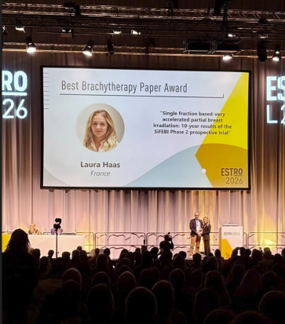
SiFEBI was a prospective, single-arm, phase II trial that involved women aged 70 years or older with low-risk breast cancer who had been treated with breast-conserving surgery. The primary endpoint was the cumulative incidence of local recurrence.
Eligible patients underwent intraoperative multicatheter implantation followed by postoperative high-dose-rate interstitial brachytherapy. This was delivered in a single fraction of 16Gy.
Forty-seven patients were initially screened to participate in the study. After application of clinical and pathological exclusion criteria, the final cohort consisted of 26 eligible patients.
The median age of the cohort was 76 years, and the median follow-up was more than 11 years (137 months). The 10-year results are particularly encouraging: there was only one local recurrence, corresponding to a 10-year rate of 5%. One regional recurrence was observed, and there were no distant metastases. The disease-free survival rate was 73%, and overall survival was 81%. Most importantly, no patient died from cancer-related causes.
Beyond oncological outcomes, the SiFEBI trial demonstrated an excellent safety profile. Late toxicity was observed in 35% of patients, corresponding to a total of 12 events. Notably, no grade III or higher rate of toxicity was observed, with the majority being breast fibroses.
In terms of cosmetic outcomes, all evaluated patients had either excellent or good results, with predominantly excellent outcomes.
These results highlight the importance of local treatment. However, the small sample size is a significant limitation, so this strategy requires validation in larger trials.
Moreover, endocrine therapy adherence was poor, with a non-adherence rate of 54%. This observation reflects a known challenge during treatment of elderly patients: treatment-related side effects often compromise adherence. Ultra-hypofractionated regimens may represent an alternative for this population.
This aligns with previously reported treatment burden in older patients, including findings from the European trial on reduction of cardiac events with perindopril in stable coronary artery disease (EUROPA).
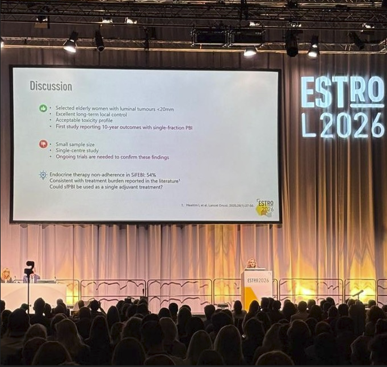
Therefore, to obtain a balance between delivery of prolonged postoperative radiotherapy that requires multiple visits and omitting irradiation but with a potentially increased risk of local recurrence, single-fraction partial-breast irradiation could be a valid compromise.
In conclusion, as breast radiotherapy continues to evolve towards increasingly hypofractionated approaches, the SiFEBI trial demonstrates the feasibility of using a single-fraction treatment, without compromising long-term outcomes. These 10-year results reinforce the role of brachytherapy in treatment de-escalation and support its integration into the treatment landscape for elderly patients with low-risk breast cancer.
GEC-ESTRO is conducting a similar study, which is examining the use of single-fraction VAPBI in low-risk invasive or ductal in-situ breast carcinoma. This is a phase II multicentre trial; it is currently recruiting and aims to include 200 patients.
Despite its small sample size and single-arm design, to our knowledge, the SiFEBI trial constitutes the first report of the use of single-fraction radiation therapy with extended long-term follow-up. The mature evidence supports its efficacy and safety in this low-risk, elderly population. The 10-year follow-up of this study can contribute to shaping the future of personalised breast cancer care.
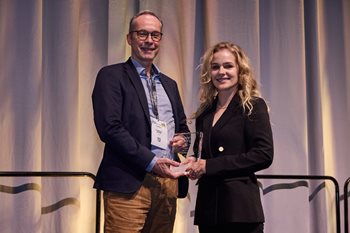
Laura Haas receiving the Best Brachytherapy Paper Award from Frank-André Siebert, chair of the brachytherapy track
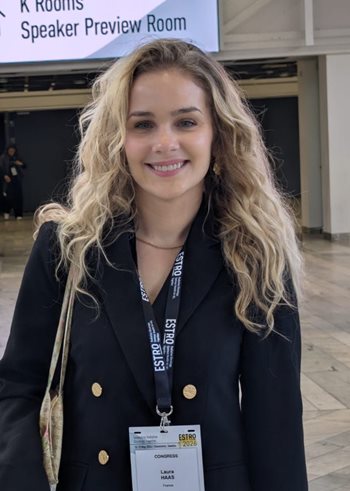
Laura Haas
Radiation Oncology Department
Henri Becquerel Cancer Centre, Rouen, France
Email: laura.haas@chb.unicancer.fr
LinkedIn: @Laura Haas
X: @LauraHaasNg